The MICROBIAL SEED COATING USING PSEUDOMONAS FLUORESCENS TO ENHANCE SHELF LIFE OF OILSEEDS
Article Sidebar
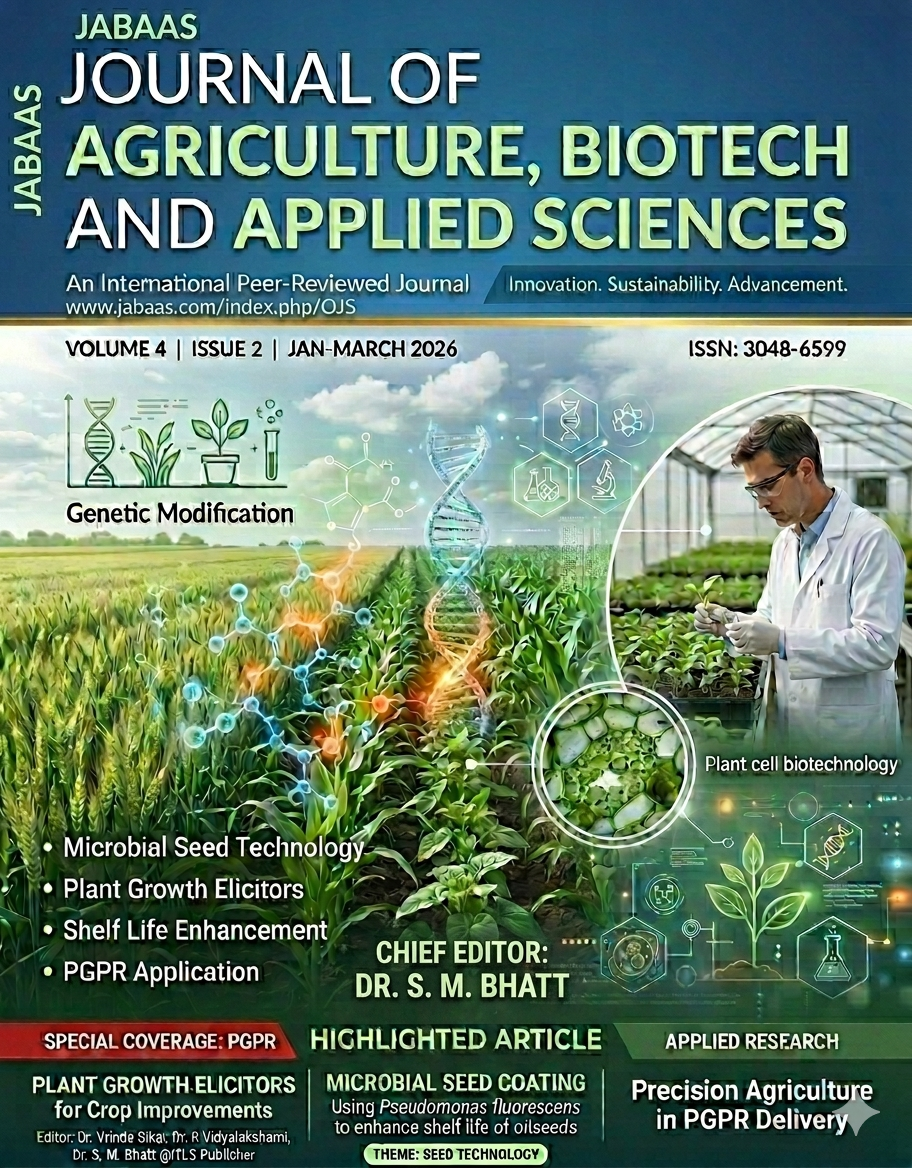
Main Article Content
Abstract
Fungal contamination is a major factor affecting the quality and storage life of oilseeds, particularly soybean, resulting in reduced germination, poor seed health, and economic losses. Although chemical pesticides are widely used for control, their long-term use raises concerns related to environmental safety and human health. Hence, the development of sustainable and eco-friendly alternatives has become essential. This study investigates the potential of Pseudomonas fluorescens as a biological seed coating agent to enhance the shelf life and quality of soybean seeds. The bacterium exhibits strong antagonistic activity against fungal pathogens through the production of antimicrobial compounds, siderophores, and lytic enzymes.
It also promotes plant defense by inducing systemic resistance, thereby increasing the ability of plants to withstand infections. Seed treatment with Pseudomonas fluorescens helps in reducing fungal load, improving germination percentage, and enhancing seedling vigor. In addition, treated seeds show better resistance to storage fungi such as Aspergillus and Fusarium, leading to improved storability and quality.
The findings of this study highlight the effectiveness of microbial seed coating as a sustainable approach for managing seed-borne pathogens and reducing post-harvest losses. This method offers a promising alternative to chemical treatments and supports the adoption of eco-friendly practices in agriculture.
Downloads
Article Details
Section

This work is licensed under a Creative Commons Attribution-NonCommercial-ShareAlike 4.0 International License.
- Attribution: You must credit the original creator, provide a link to the license, and indicate if you made changes. You can do this in any reasonable way, but you can't suggest that the original creator endorses you or your use.
- NonCommercial: You can't use the material for commercial purposes.
- NoDerivatives: If you remix, transform, or build upon the material, you can't distribute the modified material.
- You must own or control the copyright to the work.
- You can't revoke a CC license.
- Anyone who receives the material can rely on the license as long as the material is protected by copyright.
- If you created a work as part of your job, you might not own the copyright.
How to Cite


References
1. Mitchener, B., King, J., Peters, C., Peereboom, A., Dobrowolska-Haywood, M., Steinbrecher, T., & Leubner‐Metzger, G. (2025). Seed biopriming and long-term air-dry storage effects on Pseudomonas fluorescens viability and Brassica napus germination. Seed Science Research. https://doi.org/10.1017/s0960258525000054.
2. O’Callaghan, M., Swaminathan, J., Lottmann, J., Wright, D., & Jackson, T. (2006). Seed coating with biocontrol strain Pseudomonas fluorescens F113. New Zealand Plant Protection, 59, 80-85. https://doi.org/10.30843/nzpp.2006.59.4420.
3.Chin, J., Lim, Y., & Ting, A. (2022). Biopriming Pseudomonas fluorescens to vegetable seeds with biopolymers to promote coating efficacy, seed germination and disease suppression. Journal of the Saudi Society of Agricultural Sciences. https://doi.org/10.1016/j.jssas.2022.02.002.
4. J., Patta, S., Triveni, S., Keshavulu, K., Rani, K., & Raghavendra, K. (2019). Shelf life of bioagents and longevity of biologically coated pigeonpea seed. Indian Journal of Experimental Biology.
5. Chakraborty, S., Tumpa, F., & Khokon, M. (2020). Development of formulation of fluorescent pseudomonads and its evaluation on bio-management of blast of rice. Archives of Phytopathology and Plant Protection, 54, 208 - 229. https://doi.org/10.1080/03235408.2020.1826721.
6. Melkumyan, M., Babayan, B., Yesayan, A., Yesayan, T., Sevoyan, G., Grigoryan, A., & Grigoryan, A. (2025). Pseudomonas fluorescens: Prospective green antimicrobial forcrops cultivation. Bioactive Compounds in Health and Disease - Online ISSN: 2574-0334; Print ISSN: 2769-2426. https://doi.org/10.31989/bchd.v8i8.1716.
7. Paravar, A., Piri, R., Balouchi, H., & , Y. (2023). Microbial seed coating: An attractive tool for sustainable agriculture. Biotechnology Reports, 37. https://doi.org/10.1016/j.btre.2023.e00781.
8. Rocha, I., , Y., Souza-Alonso, P., Vosátka, M., Freitas, H., & Oliveira, R. (2019). Seed Coating: A Tool for Delivering Beneficial Microbes to Agricultural Crops. Frontiers in Plant Science, 10. https://doi.org/10.3389/fpls.2019.01357.
9.Cappuccino, J. G., & Sherman, N. (2014). Microbiology: A laboratory manual (10th ed.). Pearson Education.
10.Haas, D., & Défago, G. (2005). Biological control of soil-borne pathogens by fluorescent pseudomonads. Nature Reviews Microbiology, 3(4), 307–317.
11.Raaijmakers, J. M., Vlami, M., & de Souza, J. T. (2002). Antibiotic production by bacterial biocontrol agents. Antonie van Leeuwenhoek, 81(1–4), 537–547.
12.Weller, D. M. (2007). Pseudomonas biocontrol agents of soilborne pathogens: Looking back over 30 years. Phytopathology, 97(2), 250–256.
13.King, E. O., Ward, M. K., & Raney, D. E. (1954). Two simple media for the demonstration of pyocyanin and fluorescein. Journal of Laboratory and Clinical Medicine, 44(2), 301–307.
14.Compant, S., Duffy, B., Nowak, J., Clément, C., & Barka, E. A. (2005). Use of plant growth-promoting bacteria for biocontrol of plant diseases. Applied and Environmental Microbiology, 71(9), 4951–4959.
15.Subapriya, R., & Nagini, S. (2005). Medicinal properties of neem leaves: A review. Current Medicinal Chemistry, 5(2), 149–156.
16.Prasad, S., & Aggarwal, B. B. (2011). Turmeric: The golden spice. In Herbal Medicine. CRC Press.
17.Taylor, A. G., Allen, P. S., Bennett, M. A., Bradford, K. J., Burris, J. S., & Misra, M. K. (2001). Seed enhancements. Seed Science Research, 11(2), 199–213.
18.Bennett, M. A. (2010). Seed coating technologies and applications. Seed Technology, 32(2), 125–132.
19.Bauer, A. W., Kirby, W. M., Sherris, J. C., & Turck, M. (1966). Antibiotic susceptibility testing by a standardized method. American Journal of Clinical Pathology, 45(4), 493–496.